Author Resource
Top Free and Low-Cost Book Promotion Sites for Authors
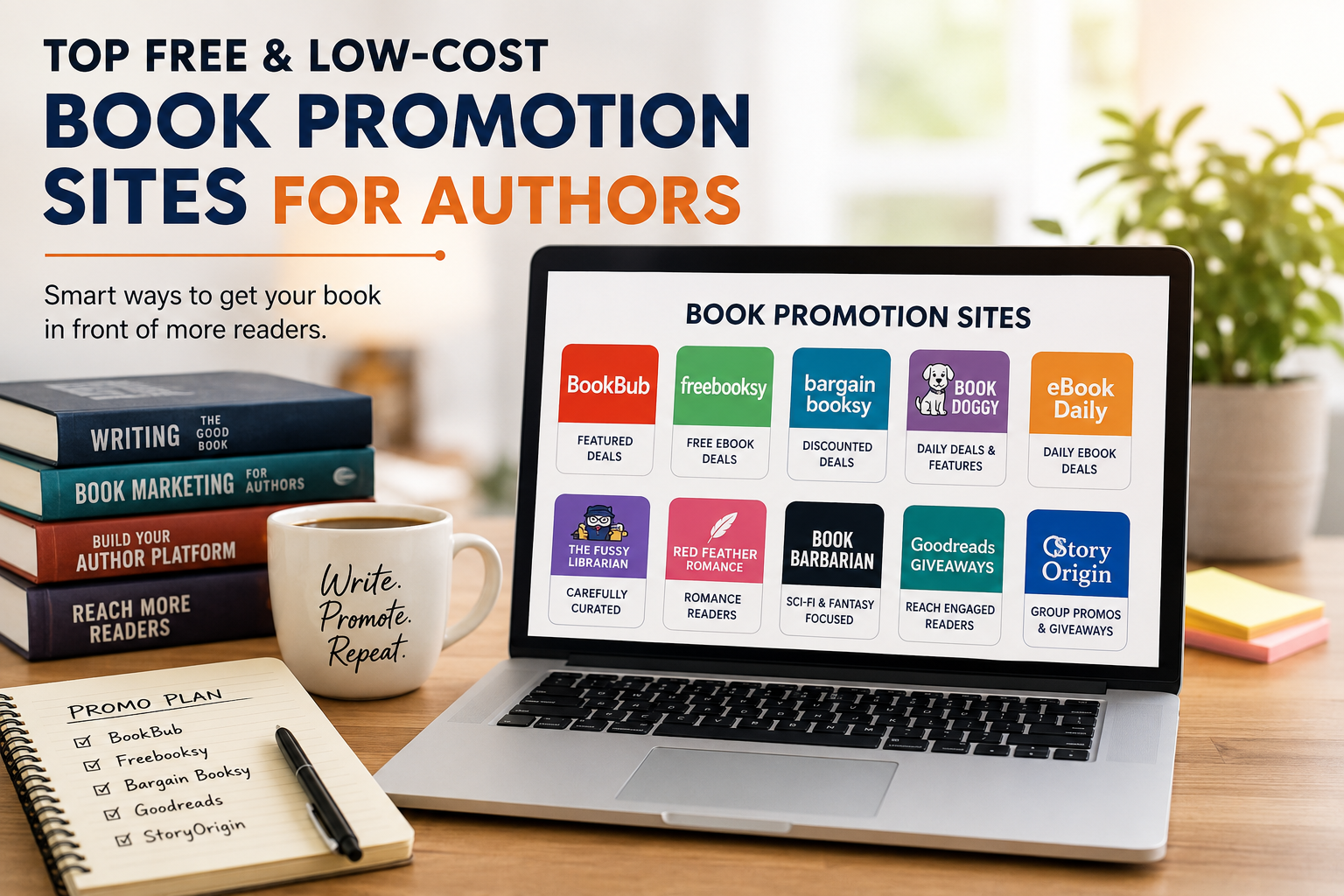
For many independent authors, book promotion begins with a simple, uncomfortable truth: the book is finished, the cover is polished, the store page is live, and still the world does not automatically notice. Online retailers are crowded. Social media is noisy. Ads can get expensive before they get useful. That is why so many authors still turn to the so-called book promotion sites: reader-facing newsletters, deal websites, genre lists, giveaway platforms, and author-to-author promo networks that help put a free, discounted, or newly released book in front of people already looking for something to read.
These sites are not magic. A weak cover, unclear blurb, thin reviews, poor category fit, or book two promoted before book one is ready can blunt even a good placement. But used carefully, promotion sites can create the thing most authors need most: a concentrated burst of reader attention. Sometimes that means free downloads. Sometimes it means 99-cent sales. Sometimes it means new subscribers, a bump in retailer rank, read-through into a series, or a few more reviews over time.
The best approach is not to ask, “Which site sells the most books?” The better question is, “Which site fits this book, this genre, this price, this stage of my career, and this budget?” As of July 2026, the following promotion sites and services remain among the most useful places for authors to consider when building a free or low-cost campaign. Pricing and requirements change often, so authors should always check each site before booking.
How Book Promotion Sites Work
Most book promotion sites operate around one of four models. The first is the classic deal newsletter: readers sign up by genre, and the site emails them free or discounted books. BookBub, Freebooksy, Bargain Booksy, Robin Reads, The Fussy Librarian, and Ereader News Today all fit broadly into this category.
The second model is the budget listing site, where an author pays a small fee, or sometimes nothing, to have a book posted on a website, social feed, or smaller newsletter. Awesome Gang, BookDoggy, eBookDaily, ManyBooks, Book Bongo, and BookRaid sit closer to this end of the market.
The third model is genre-specific promotion. Book Barbarian is focused on science fiction and fantasy. Red Feather Romance is built for romance readers. These can be especially useful because a smaller but better-matched audience often outperforms a larger general list.
The fourth model is collaborative or platform-based promotion: Goodreads Giveaways, StoryOrigin, and BookFunnel help authors reach readers through giveaways, swaps, group promotions, review teams, and direct reader-magnet distribution rather than a single deal email.
The strongest results usually come from matching the site to the campaign. A free first-in-series fantasy novel has different needs from a full-price nonfiction launch. A romance box set at 99 cents belongs in different places than a literary debut seeking early reviews. The sites below are not ranked only by size; they are ranked by usefulness for budget-conscious authors building a practical promotion plan.
1. BookBub Featured Deals
BookBub is the name authors usually mention first, and for good reason. Its Featured Deals remain one of the most powerful curated ebook promotion opportunities in the market. BookBub says its Featured Deals are sent to readers according to genre preferences and that pricing varies by category, book price, and region. Its own partner pages describe Featured Deals as a way to reach large groups of readers with free or discounted ebooks. (bookbub.com)
BookBub is not usually “low-cost” in the ordinary sense. Depending on genre, region, and discount level, it can be one of the most expensive options on this list. But it belongs here because a free or discounted BookBub deal can still be cost-effective for authors with a strong series, professional packaging, and clear read-through. It is especially useful when book one is free or 99 cents and later books are ready to absorb new readers.
Best for: authors with polished books, strong reviews, and a backlist.
Watch out for: competitive acceptance, higher cost, and the temptation to apply before the book is truly ready.
2. Freebooksy
Freebooksy is one of the most recognizable free-book newsletters for indie authors. It is designed for books that are temporarily free or permafree, and Written Word Media’s support pages state that Freebooksy only promotes free ebooks on the promotion date. (support.writtenwordmedia.com) The site also offers editorial submissions, described as a free opportunity to be considered for its audience, though placement is not guaranteed. (freebooksy.com)
For authors using KDP Select free days, Freebooksy is often a natural fit. It works especially well when the free title is the first book in a series and the author has clean back matter directing readers to the next book, newsletter, or bonus content. A free download is not the same as a sale, but for series authors, a high-volume free promo can create later revenue if readers continue.
Best for: free first-in-series ebooks, permafree lead magnets, KDP Select free promotions.
Watch out for: freebie readers who download more books than they read.
3. Bargain Booksy
Bargain Booksy is Freebooksy’s paid-book sibling. It promotes discounted books rather than free ones and says it is appropriate for books priced between 99 cents and $4.99. (bargainbooksy.com) Its author page says a feature can help drive sales, find new readers, generate reviews, and improve retailer rank.
This is a practical choice for authors who do not want to set a book to free. A 99-cent or $1.99 promotion can preserve some revenue while still offering readers a clear deal. Bargain Booksy can be especially useful for box sets, first-in-series novels, and genre fiction with a strong commercial hook.
Best for: discounted fiction and nonfiction, especially 99-cent campaigns.
Watch out for: weaker ROI on books with no series read-through or small review counts.
4. Robin Reads
Robin Reads is a curated daily-deal newsletter that promotes free and 99-cent books. Its author signup page lists genre-specific subscriber counts and prices, with categories such as mystery, thriller, romance, nonfiction, science fiction and fantasy, horror, and dystopia. It also notes that books should be free or 99 cents. (robinreads.com)
Robin Reads sits in a useful middle zone: more curated and selective than some budget sites, but generally less expensive than BookBub. Authors often use it as part of a stacked campaign, placing it between or alongside Freebooksy, Bargain Booksy, Fussy Librarian, and ENT.
Best for: genre fiction with a clean hook and a strong discount.
Watch out for: limited slots and genre fit.
5. The Fussy Librarian
The Fussy Librarian is a long-running author favorite because it combines genre targeting with relatively approachable prices. Its advertising pages separate bargain ebook promotions from free ebook promotions. For bargain promotions, it notes that ebooks should be priced at $5.99 or less on the day of promotion, while its author portal lists free ebook promotion categories and prices by genre. (authors.thefussylibrarian.com) (authors.thefussylibrarian.com)
The Fussy Librarian is useful for authors testing promotion without committing a large budget. It is also helpful because the audience is segmented by reader preference, which matters more than raw list size. A smaller list of readers who actually want cozy mystery may be worth more than a larger undifferentiated audience.
Best for: authors seeking affordable, genre-targeted email exposure.
Watch out for: minimum review requirements in some categories and the need to book ahead.
6. Ereader News Today
Ereader News Today, often called ENT, promotes free and bargain books and accepts deals available on Amazon as well as other major retailers such as Barnes & Noble/Nook, Google Play, Apple Books, and Kobo. Its submission page says books should be free or on sale, though 99-cent regular-price books may also be considered, and generally asks for full-length books of at least 125 pages, with exceptions for children’s books, nonfiction, and cookbooks. (ereadernewstoday.com)
ENT is especially attractive for wide authors because not every promo site gives meaningful attention to non-Amazon retailers. It can work well in a stacked discount campaign where the author wants to maintain momentum across several days.
Best for: free or discounted books, including wide titles.
Watch out for: page-length and pricing requirements.
7. BookDoggy
BookDoggy is one of the more affordable deal-promotion options. Its author page advertises bulk discounts and lists reduced rates for authors purchasing multiple promo codes, including lower per-promotion prices for free and non-free books. (bookdoggy.com) BookDoggy also became part of Written Word Media’s broader promotion ecosystem, with Written Word Media announcing expanded author reach through BookDoggy promos. (writtenwordmedia.com)
BookDoggy is useful for authors who want to fill out a promo stack without spending heavily on every slot. It is not usually treated as a single-campaign centerpiece, but as a low-cost supporting placement it can make sense.
Best for: budget stacking, especially free or near-free ebooks.
Watch out for: smaller reach than premium newsletters.
8. BookRaid
BookRaid has a distinctive pay-per-click model. Its pricing page states that free book promotions cost 15 cents per click, 99-cent promotions cost 20 cents per click, and $2.99 promotions cost 60 cents per click, with a minimum charge. (bookraid.com) Its partner page also notes that promotions have a maximum spend of $60. (bookraid.com)
That cap makes BookRaid appealing to authors who are nervous about open-ended ad costs. You pay based on response, up to a ceiling, rather than committing to a larger flat fee. This can be a sensible test for authors with a tight budget.
Best for: authors who want capped, click-based exposure.
Watch out for: click quality, genre fit, and whether the landing page converts.
9. Book Barbarian
Book Barbarian is a genre-specific promotion site for science fiction and fantasy. Its author page emphasizes simple booking and a reader audience focused on those genres. (bookbarbarian.com) Its pricing page describes transparent pricing for promoting science fiction or fantasy books, including a Free Book of the Day option. (bookbarbarian.com)
For the right book, this kind of niche list can be powerful. A space opera, epic fantasy, urban fantasy, LitRPG, or military sci-fi title may do better in front of committed genre readers than on a broader list where interest is diluted.
Best for: science fiction and fantasy authors.
Watch out for: poor fit if the book only lightly touches speculative elements.
10. Book Cave
Book Cave promotes ebooks and audiobooks to readers and says its retailer promotions can reach more than 350,000 readers through subscribers and social followers. (mybookcave.com) Its pricing page describes feature pricing for ebook and audiobook promotion, while its submission guidelines say it will consider ebooks priced up to $2.99, though prices above 99 cents are usually reserved for box sets or special cases. (mybookcave.com) (mybookcave.com)
Book Cave is also useful because it thinks beyond a single deal email. Authors can use it for reader magnets, giveaways, and ongoing discovery, which makes it a bridge between classic promo sites and list-building tools.
Best for: discounted ebooks, audiobooks, reader magnets, and series funnels.
Watch out for: pricing restrictions and category expectations.
11. Red Feather Romance
Red Feather Romance is a romance-specific promotion site owned by Written Word Media. Its author page says it reaches more than 394,000 romance readers and offers free ebook, 99-cent-plus ebook, and series promo products. (redfeatherromance.com) Written Word Media’s support page says Red Feather Romance daily newsletter promotions vary by genre and feature type, with prices ranging from $85 to $185, while dedicated email promotion costs more. (support.writtenwordmedia.com)
Romance authors should pay close attention to subgenre fit. Contemporary, paranormal, historical, western, romantic comedy, sweet romance, and steamy romance readers do not all behave the same way. Red Feather Romance’s value is that it starts with a romance-specific audience.
Best for: romance authors with clear subgenre positioning.
Watch out for: sending the wrong heat level or subgenre to the wrong audience.
12. ManyBooks
ManyBooks offers newsletter promotion for discounted or free ebooks and says its daily newsletter reaches more than 200,000 subscribers. (manybooks.net) Its author-services page lists newsletter promos and permafree promotion among its services. (manybooks.net) A ManyBooks feature application page lists a $29 promotion price. (manybooks.net)
ManyBooks is a good example of a lower-cost site that can make sense as part of a broader campaign. It may not carry the prestige or force of BookBub, but the entry price is approachable, and the site has a long-standing reader-facing identity.
Best for: free or discounted ebooks needing affordable extra exposure.
Watch out for: making sure your genre performs well with its audience.
13. Awesome Gang
Awesome Gang is a budget-friendly promotion site with free and paid options. Its submission page invites authors to submit books for promotion, and its testimonials page mentions a featured option for $10. (awesomegang.com) (awesomegang.com) Awesome Gang also maintains a list of places where authors can submit books for free promotion. (awesomegang.com)
This is not a premium curated newsletter in the BookBub sense. It is better understood as inexpensive visibility. For new authors with tiny budgets, that can still be useful, especially when paired with other outreach.
Best for: very low-cost exposure and author interviews.
Watch out for: modest impact if used alone.
14. eBookDaily
eBookDaily focuses on one-day free Kindle book deals. Its reader-facing homepage says it emails personalized $0 Kindle freebies every day, with each ebook free for one day only. (ebookdaily.com) Its author page says freebie submissions are currently pay-what-you-want through its author site. (ebookdaily.com)
For authors running a KDP free day, eBookDaily can be an inexpensive supporting option. It is especially relevant when the goal is download volume rather than immediate revenue.
Best for: one-day free Kindle promotions.
Watch out for: limited usefulness for paid campaigns.
15. Book Bongo
Book Bongo describes itself as an ebook promotion service for authors and publishers, featuring books that are free or discounted on Amazon. (bookbongo.com) Its site also describes its role as delivering book deals to Kindle readers and helping authors and publishers promote. (bookbongo.com) Secondary reviews describe Book Bongo as offering a free “Bongo Boost” and paid tiers beginning at low prices, though authors should verify current packages directly before booking. (selfpublishing.com)
Book Bongo is another budget-stack option. It is useful when an author wants a low-cost addition to a free or 99-cent promotion and is realistic about results.
Best for: inexpensive Amazon-focused ebook visibility.
Watch out for: checking current package availability and reach.
16. NewInBooks
NewInBooks is more launch-oriented than bargain-stack oriented. Written Word Media’s support page describes NewInBooks Book Launches as advertising placements for self-published authors and small publishers, while another support page says launches range from $299 to $799 depending on genre. (support.writtenwordmedia.com) (support.writtenwordmedia.com)
Because of that price range, NewInBooks is not a “cheap” site in the same way as Awesome Gang or ManyBooks. Still, it can be low-cost compared with hiring a full launch team, especially for authors who want a new release introduced to readers rather than merely discounted.
Best for: new releases with a defined launch budget.
Watch out for: using it on a book without strong packaging or a clear audience.
17. Goodreads Giveaways
Goodreads Giveaways are not deal newsletters, but they remain a major discovery tool. Goodreads lists a Standard giveaway package at $119 and a Premium package at $599. (goodreads.com) Goodreads’ help material describes giveaways as a promotional tool authors and publishers can use to increase visibility and generate early reviews. (help.goodreads.com)
Giveaways are best thought of as awareness and review-seeding tools rather than direct-sales machines. They can be useful around launches, especially when the author wants readers to add the book to shelves and increase visible interest before or near publication.
Best for: launches, review visibility, and reader awareness.
Watch out for: expecting immediate sales ROI from a giveaway.
18. StoryOrigin
StoryOrigin is a collaborative author-marketing platform rather than a traditional promo newsletter. Its homepage describes tools for finding reviewers, building a mailing list, increasing sales through newsletter swaps and group promos, and managing campaigns. (storyoriginapp.com) Its pricing page says accounts can be free, with paid plans listed at $10 per month or $100 per year. (storyoriginapp.com)
StoryOrigin is valuable for authors willing to participate actively. Newsletter swaps and group promos require judgment: you need compatible authors, a relevant reader magnet or sale, and a list that you treat responsibly. But for authors building long-term readership rather than chasing one-day spikes, it can be one of the better values.
Best for: list-building, newsletter swaps, group promos, review teams.
Watch out for: low-quality swaps and poorly matched group promos.
19. BookFunnel
BookFunnel is best known for ebook delivery, but its author knowledge base also describes group author promotions, including newsletter promos and sales promos. (authors.bookfunnel.com) Its sales-promo help page says authors can find recruiting promos through the BookFunnel dashboard. (authors.bookfunnel.com) BookFunnel pricing starts with author plans, with different tiers depending on features. (bookfunnel.com)
For promotion, BookFunnel shines when authors already understand reader magnets. A free novella, bonus story, prequel, sample bundle, or first-in-series can become a clean entry point into an email list. Unlike a deal newsletter, BookFunnel helps authors own the reader relationship after the click.
Best for: reader magnets, group promos, direct delivery, newsletter growth.
Watch out for: collecting subscribers without a follow-up sequence.
Building a Smart Low-Cost Promo Stack
A good promotion stack is not just a pile of dates. It is a short campaign with a purpose. Before booking anything, decide what success means.
If the goal is downloads, use a free first-in-series and focus on Freebooksy, eBookDaily, Fussy Librarian free promos, BookDoggy, BookRaid, Book Cave, ManyBooks, and perhaps BookBub if accepted. If the goal is paid sales, use 99 cents and look at Bargain Booksy, Robin Reads, ENT, Fussy Librarian, BookRaid, ManyBooks, BookDoggy, and genre-specific sites. If the goal is launch visibility, consider NewInBooks, Goodreads Giveaways, BookBub New Release tools, StoryOrigin swaps, and a carefully planned newsletter sequence. If the goal is long-term audience building, use BookFunnel and StoryOrigin with reader magnets rather than relying only on one-day deal traffic.
Authors should also plan the order. Many stack promotions over three to five days, starting with smaller sites, placing the strongest promotion in the middle, and using supporting sites afterward to extend rank momentum. Others put the biggest promotion first to create a spike and then use smaller sites to keep the book visible. There is no universal rule, but there is one reliable mistake: booking promotions before the book page is ready.
Before spending money, check five things. First, the cover must immediately signal genre. Second, the blurb must make the premise clear in a few seconds. Third, the book should have enough reviews to reduce reader hesitation, if possible. Fourth, the discounted price should feel like a real deal. Fifth, the back matter should tell readers what to do next: buy book two, join the newsletter, claim a bonus, leave a review, or follow the author.
Free vs. 99 Cents: Which Works Better?
Free promotions tend to generate more downloads. That can help with visibility, especially for first-in-series books. The downside is that free readers may be less committed. Some download dozens of books and never open them.
A 99-cent promotion usually produces fewer units but more intentional buyers. It can also preserve retailer-sales signals better than a free campaign, depending on platform and strategy. For authors with only one book, 99 cents may feel more sustainable. For authors with a series, free can work beautifully if later books convert.
Amazon KDP’s own promotion tools matter here. KDP describes Free Promotions, Kindle Countdown Deals, Amazon Advertising, Author Central, and preorders as promotion options for authors. (kdp.amazon.com) A smart author uses external promo sites in combination with retailer tools, not as a replacement for them.
Final Recommendations
For most budget-conscious authors, the best starting stack is not the most expensive one. A practical first test might include The Fussy Librarian, BookDoggy, ManyBooks, BookRaid, Awesome Gang, and either Freebooksy or Bargain Booksy depending on whether the book is free or discounted. Genre authors can add Book Barbarian for sci-fi/fantasy or Red Feather Romance for romance. More established authors can apply for BookBub and use it as the centerpiece if accepted.
The deeper lesson is this: promotion sites amplify what is already there. They do not fix a confused book page. They do not create read-through where no next book exists. They do not turn the wrong audience into the right one. But when a strong book meets the right readers at the right price, these sites can still do what authors need them to do: open a door, create motion, and let a book step briefly out of the crowd.